

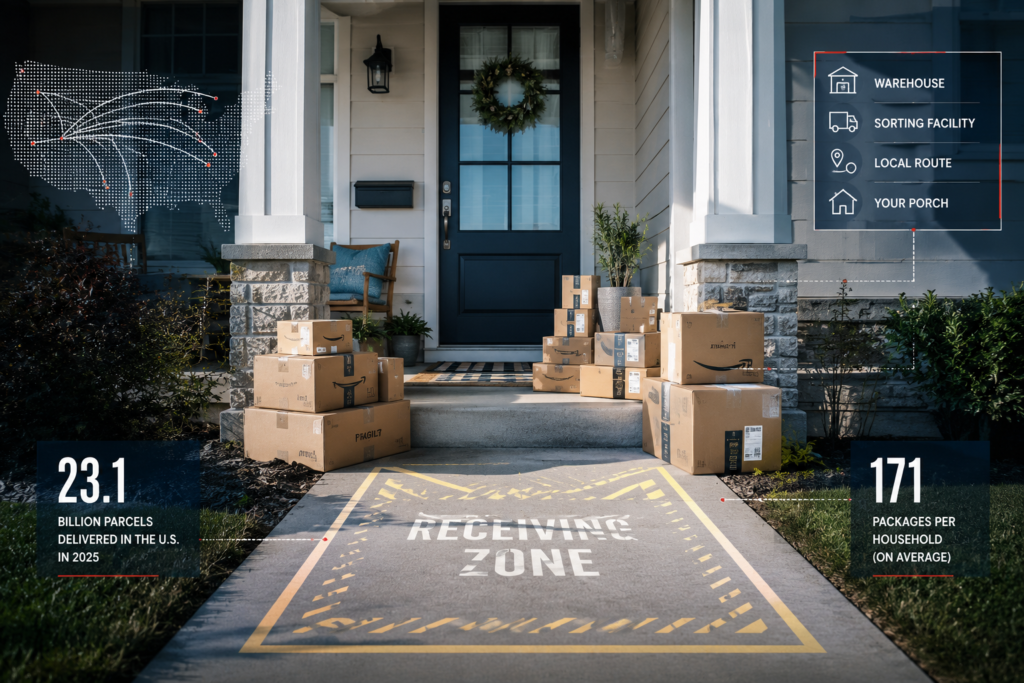
Twenty-five years ago, online shopping barely existed. Today, Americans receive more than 23 billion parcels a year. We transformed the way we shop, but left the final five feet of delivery almost untouched.
Think back to 2000.
Not the 1950s. Not some black-and-white version of America where everyone knew the mailman’s name. Just 25 years ago.
You may have had a Nokia in your purse and a phone attached to a wall somewhere in your house. A Target run was an actual Target run. If you needed a prescription, you went to the pharmacy. If you bought a computer, chances are you brought the computer home yourself.
Amazon existed. So did online shopping. We just weren’t living our lives through cardboard boxes yet.
In 2000, e-commerce accounted for less than 1 percent of U.S. retail sales during most of the year, according to the U.S. Census Bureau. Even during the holiday-heavy fourth quarter, it accounted for only about 1.1 percent.
The front porch had a much smaller job then.
Most of what we bought came through the front door because we carried it through the front door ourselves.
Today, groceries arrive while we’re at work. We order mattresses without lying on them first, clothes without trying them on, and computers without ever seeing the computer until a driver leaves it at our house.
Somewhere along the way, the front porch got a promotion.
Nobody announced it. Nobody redesigned it for the job. We simply started sending more and more of our lives there.
"The porch didn't change. We did."
How did the front porch become part of the supply chain?
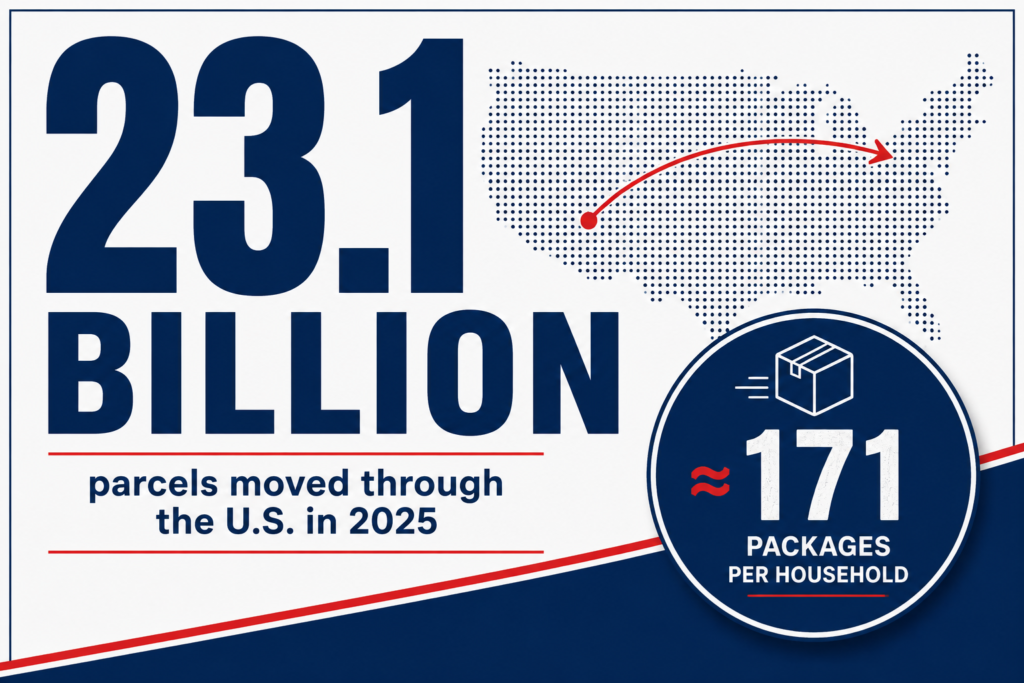
That works out to roughly 171 packages for every household in the country. Pitney Bowes expects U.S. parcel volume to approach 31 billion by 2031.
Twenty-five years ago, online shopping barely registered as a percentage of American retail. Today we’re moving tens of billions of parcels through a delivery system that has become almost invisible to us precisely because it works so well.
Think about what has to happen between clicking Place Order and hearing something land outside your door.
Retailers operate enormous fulfillment centers filled with inventory that software can locate in seconds. Packages move through conveyor systems, sorting facilities, trucks and airplanes. Carriers optimize routes using data that would have been unimaginable to the person waiting six to eight weeks for something ordered from a catalog.
The customer gets a tracking number before the box has gone very far. We can see when it reaches another state, when it arrives in Orlando, and when it gets loaded onto the truck that morning. Some services will show you where the delivery vehicle is while you’re waiting.
Billions of dollars and decades of innovation have gone into making that journey faster, cheaper and more predictable.
Then the driver reaches your house.
And after all that technology, the designated receiving facility is very often a few feet of concrete beside the front door.
There is something wonderfully absurd about that.
We have spent decades perfecting nearly every mile of a package’s journey and left the last few feet remarkably similar to what they were when hardly anything was being delivered there.
The delivery industry has a name for those last few feet
Researchers at the University of Washington’s Urban Freight Lab study what they call the Final 50 Feet.
It’s the least glamorous part of logistics, but one of the most complicated. A package can travel thousands of miles successfully and still require a driver to find somewhere to park, enter a building, locate the right unit or recipient, and complete the delivery.
Researchers have studied parcel lockers and other consolidated delivery points because those final feet can create an enormous amount of inefficiency.
Residential delivery found an elegant shortcut.
The recipient doesn’t necessarily have to be there.
The driver can leave the package, photograph it and continue to the next stop.
From a logistics standpoint, that’s brilliant.
From the package owner’s standpoint, something else has happened: responsibility for the contents of the box has moved from one of the most sophisticated logistics networks ever created to an empty house.
We don’t talk much about that handoff.
Perhaps because we’ve gotten so used to it.
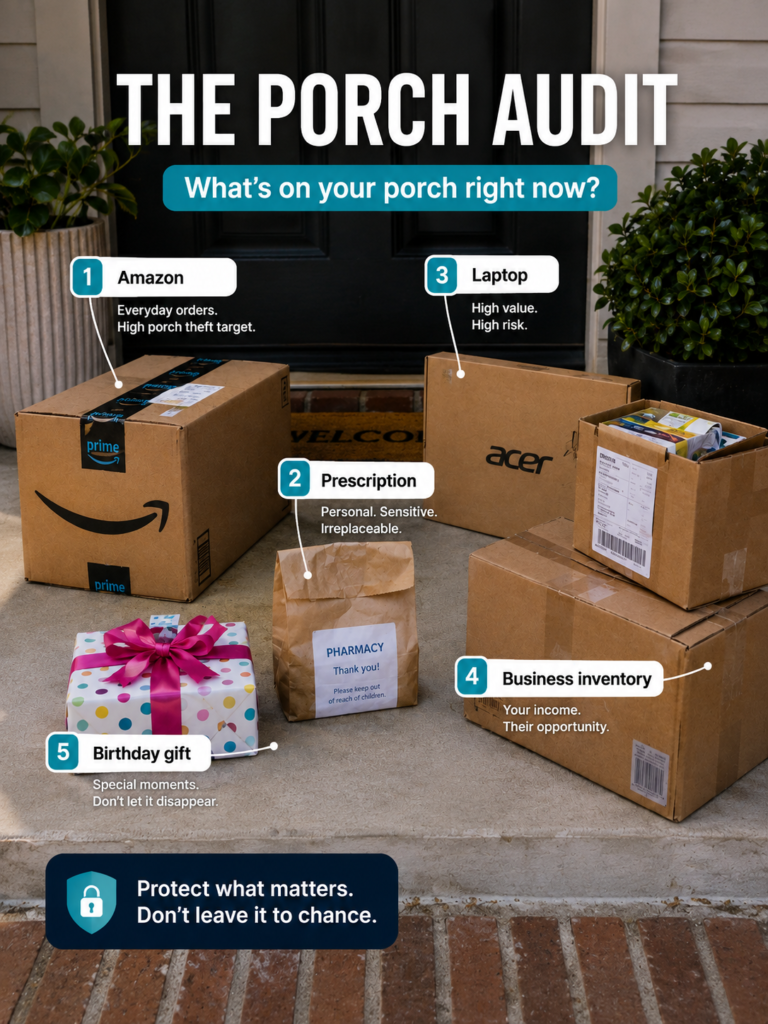
💡 Today's front porch might receive business inventory in the morning, prescription medication at lunch, groceries in the afternoon, and birthday gifts before dinner.
What's inside the box has changed too
There was a time when a package arriving at the house was enough of an event that you were curious about who sent it. Now you can have three boxes waiting at the door and need to check your order history to remember what’s in them.
That familiarity has made the cardboard box strangely anonymous. From the street, the package holding a month’s supply of dog treats doesn’t look much different from the one holding a new laptop, a prescription or several hundred dollars’ worth of inventory for someone’s business.
We know the difference because we placed the order.
The porch doesn’t.
And we’re putting more than personal purchases out there.
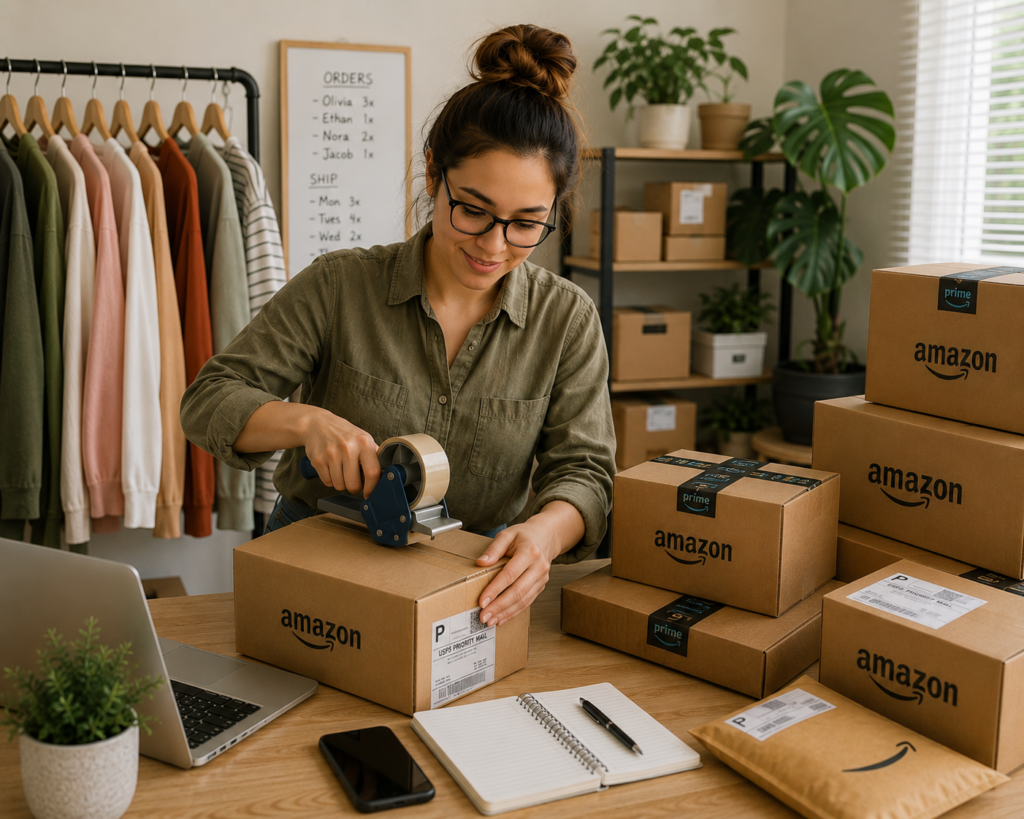
For millions of Americans, home is also where they run a business. Inventory arrives there. So do equipment, supplies, product samples and returns. A space that once handled the occasional delivery can now find itself serving as the unofficial loading dock for a company.
Except a loading dock usually has someone there to receive what’s being delivered.
Most porches don’t.
Which brings us to the part of this story that gets most of the attention: package theft.
Oddly enough, it may not be the most interesting part.
We don't actually know how many packages disappear
In 2025, the U.S. Postal Service Office of Inspector General took a close look at package theft in America and came to a surprisingly unsatisfying conclusion.
Nobody really knows how much of it is happening.
There is no single authoritative national source tracking packages stolen after delivery. The estimates cited by the Inspector General ranged from about 58 million stolen packages annually to 120 million. Estimates of the financial losses ranged from roughly $5.2 billion to $16 billion.
That’s not a small statistical disagreement.
It’s a canyon.
There are good reasons for the uncertainty. A package that disappears might be reported to the retailer, the carrier, local police, an insurance company or some combination of them. Plenty are simply replaced by the seller and never become part of any official theft count.
So I don’t think there’s much value in pretending we know exactly how many porch pirates are roaming American neighborhoods.
The more interesting fact is that we don’t know.
We built a delivery system capable of moving more than 23 billion parcels a year with astonishing precision. We can watch a box travel from a warehouse, onto a truck, through a sorting facility and down our street.
After that, our ability to account for what happens becomes surprisingly fuzzy.
So we started watching the porch
The rise of home delivery created another market right alongside it.
We bought doorbell cameras and motion lights. Delivery apps began telling us the moment a package arrived. Some of us bought porch lockboxes or started requesting signatures for expensive orders. We text neighbors from work and ask if they’ll grab a box before the afternoon rain gets to it.
None of those things is unreasonable. In fact, some are very useful.
But there’s something revealing about how much effort we’ve put into managing the hours after a package has been delivered.
The doorbell camera may be the perfect symbol of it.
A package arrives while you’re sitting at work. Your phone buzzes. You open an app and there it is in high definition: the computer you ordered, sitting next to your welcome mat.
You know exactly when it arrived. You know which corner of the porch it’s sitting on. Depending on your camera, you may even know who walks past it.
What you can’t do is bring it inside.
We’ve gotten remarkably good at watching our packages wait for us.
Maybe we've been solving the wrong problem
That doesn’t mean abandoning home delivery. I own a shipping store and I still have packages delivered to my house.
Of course I do. It’s convenient.
The interesting thing about convenience, though, is how quickly it turns into habit.
Most of us aren’t making a conscious delivery decision every time we order something. Our home address is already saved. The checkout page remembers it. We click it and move on.
The $14 order goes there.
So does the $1,400 one.
That’s not necessarily a problem. But it is worth noticing that we’ve turned two very different purchases into the same delivery decision simply because one address happens to autofill.
The industry itself seems to recognize that the front door can’t be the only answer.
UPS operates Access Point locations where eligible packages can be delivered or redirected for later pickup. FedEx offers hold-at-location options. Amazon has lockers and pickup locations. Retailers increasingly offer their own versions of buy online and pick up somewhere else.
These aren’t fringe alternatives anymore. They’re becoming another layer of the delivery infrastructure.
After decades spent answering How quickly can we get this to your house?, the more interesting question may eventually become Where do you actually want us to leave it?
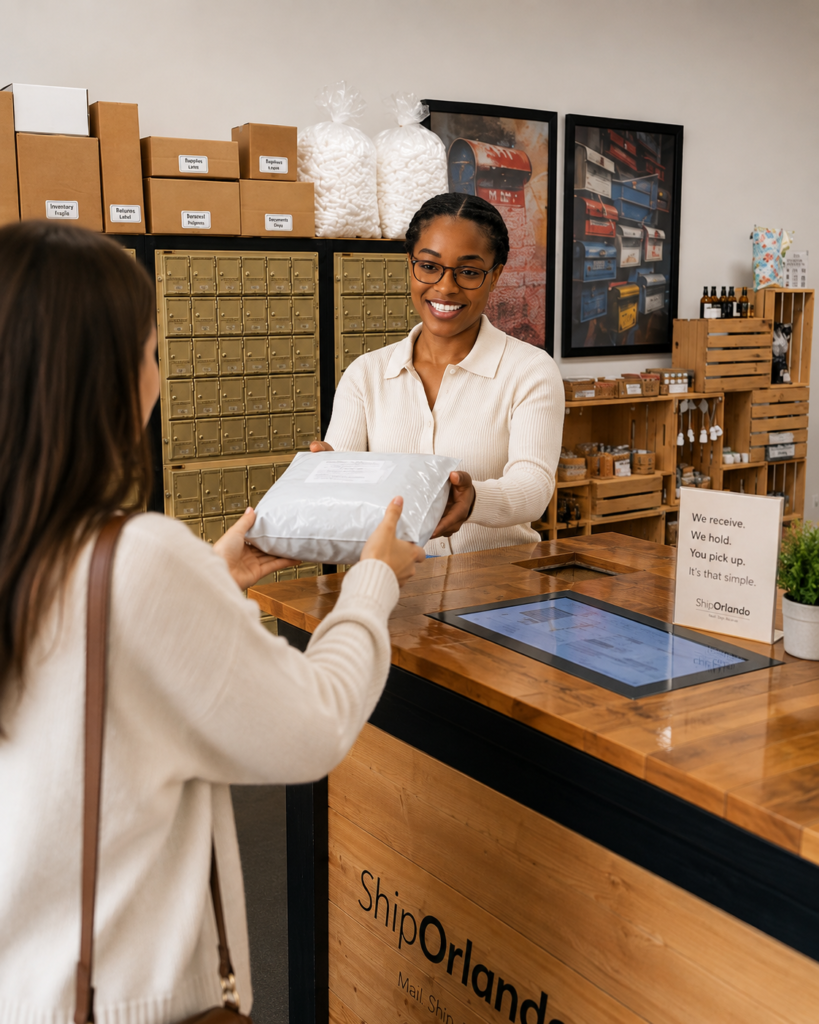
I see this differently now because I spend my days around other people's packages
I own a shipping and mailbox store in Orlando, which means cardboard boxes occupy a strangely large part of my life.
I see the package that belongs to someone who’s traveling and doesn’t want it delivered to an empty house.
I see inventory for a small business.
I see boxes for people who live in apartments and don’t particularly trust where deliveries are left.
I see the thing someone ordered that matters enough to them that they deliberately chose somewhere else for it to go.
Working behind that counter has changed the way I look at packages sitting outside houses.
Not because I assume they’re going to be stolen.
Most aren’t.
And not because I think home delivery is a bad idea.
It isn’t.
What strikes me is how rarely we think about the destination anymore.
Twenty-five years ago, that decision barely existed because most of our purchases weren’t coming to us this way.
Now the average American household receives roughly 171 parcels a year, and the number is still climbing.
We changed how we shop.
We changed how we work.
We changed what gets delivered to our homes and how often it arrives.
The logistics industry changed almost everything required to make that possible.
Our houses didn’t.
The porch is still a porch.
Maybe there’s an overhang now. Maybe there’s a camera beside the door. Maybe the camera can recognize your face and tell the difference between you and the FedEx driver.
But it’s still a few feet of space outside your home.
And we’ve quietly asked it to become the receiving department for modern American life.
The porch didn’t change. We did.
Maybe your porch isn’t broken.
Maybe it’s just doing a job it was never designed to do.
What if your packages had somewhere else to go?
That question is part of why we created The Drop Spot at Ship Orlando.
It’s simply another delivery address for the times when you’d rather not have a package waiting outside your home.
You send it to us. We receive it inside. It waits here until you’re ready to pick it up.
For September, new Drop Spot customers can try their first month on us.
Not every package needs somewhere else to go.
But after 23 billion of them, maybe we should stop assuming every package belongs on the porch.
This post is for informational purposes only and does not constitute legal advice. Every business situation is different. For questions specific to your LLC, consult a licensed Florida attorney or CPA.
