

You open Sunbiz to register your LLC. You’re ready to make it official.
Then you hit the address field.
You pause for a second… and type in your home address.
Because it’s easy.
Because it’s yours.
Because you think it’s just paperwork.
That’s the moment most Florida business owners don’t think twice about.
At Ship Orlando, located in College Park, we help Florida business owners set up compliant, private business addresses every week.
And most people don’t realize how public that decision becomes.
In Florida, LLC addresses are public record through Sunbiz, which means anyone can search and find them.
When you file an LLC with the Florida Division of Corporations, you are not submitting private paperwork to a back office somewhere. You are publishing information into a public database that anyone can search.
Not “people in government.”
Anyone.
Your principal address.
Your mailing address.
Your registered agent.
Your name.
Your annual reports.
All searchable.
Florida’s public records system is designed for transparency. That’s good for commerce.
It’s not great for privacy.
I’ve watched this play out inside Ship Orlando more times than I can count.
Someone registers their LLC using their home address.
Months later, they Google their business name.
And there it is.
Their house.
Mapped.
Indexed.
Attached to their company.
That’s usually when it clicks.
Because Sunbiz isn’t the only place that information lives. Data aggregators pull from public records. Search engines index them. Third-party sites replicate them.
And while you can update your address later, public filings don’t disappear. They stack.
Using your home address for your LLC isn’t illegal.
It’s just short-term thinking.
An address is not just where mail goes. It becomes part of your business identity — legally, publicly, and permanently.
And once your home is tied to your LLC, the line between personal life and business life gets thinner.
That’s not dramatic.
It’s structural.
Before we talk about compliance or strategy, you have to understand this first:
Your LLC address is not a formality.
It’s infrastructure.
How Using Your Home Address for an LLC Affects Your Privacy
It’s not about one big moment of exposure.
It’s about understanding how exposure compounds.
Using your home address for your LLC doesn’t create one big problem. It creates small, layered vulnerabilities that build over time.
The Five Ways Exposure Compounds Over Time:
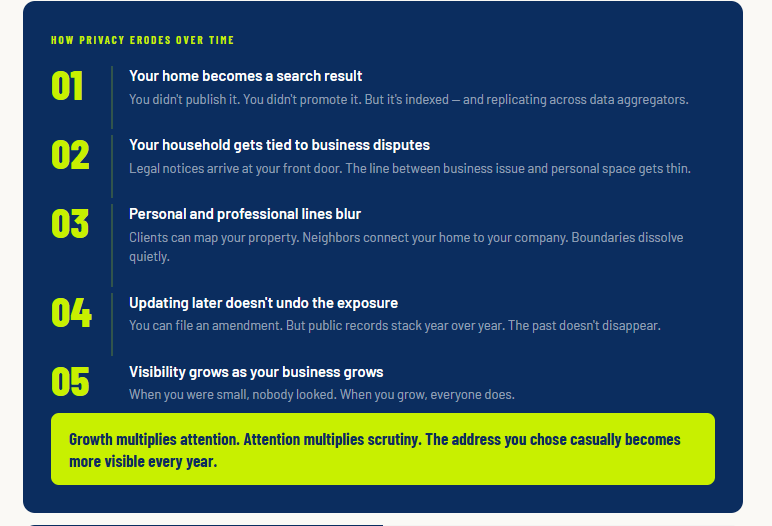
1. Your Home Becomes a Search Result
You already know Sunbiz is public.
Now when someone searches your name and business together, your home address may appear in multiple places.
You didn’t publish it.
You didn’t promote it.
But it’s indexed.
Privacy isn’t usually lost in a dramatic moment.
It’s lost quietly through replication.
2. Your Household Gets Tied to Business Disputes
Most businesses operate smoothly.
But when conflict happens, it hits differently when your home is the listed address for legal notices.
Even if no one ever shows up.
The psychological line between “business issue” and “personal space” gets thinner.
That’s not a horror story. That’s what happens when you treat an address field like a formality.
And that tension matters more than people admit.
3. Your Personal and Professional Boundaries Blur
An address is a boundary.
When your home becomes your LLC address, clients can map your property, neighbors connect your residence to your company, and your business identity merges with your household.
That might not bother you at first.
But as your business grows, visibility increases.
And increased visibility changes how exposure feels.
4. Updating Later Doesn’t Undo Exposure
Here’s the part that surprises people.
Yes, you can file an amendment with the Florida Division of Corporations.
Yes, you can update your mailing address.
But public records build year by year.
Updating protects the future.
It doesn’t erase the past.
That’s why the initial decision carries weight.
“Filing a Statement of Change of Registered Agent with Sunbiz costs $25. Updating your address across every system you’ve built on the wrong foundation costs significantly more — in time if nothing else.”
5. Visibility Increases as You Grow
This is the one people never consider at formation.
When your business is small, almost no one looks you up.
When your business grows, more people do.
- Clients verify.
- Vendors research.
- Competitors observe.
- Banks review.
The more successful you become, the more searchable you become.
Growth multiplies attention.
And attention multiplies scrutiny.
Using your home address is legal.
It’s common.
It’s fast.
But it removes a layer of separation between your life and your company.
And once separation is gone, restoring it later is harder than building it correctly from the beginning.
Privacy is not dramatic.
It’s structural.
Now that we’ve looked at privacy through that lens, the next logical question is:
What does Florida actually require — and where do you have flexibility?
That’s where we go next.
What Florida Actually Requires (And What It Doesn’t)
This is where things get less emotional and more practical.
Because once you strip away the fear and the assumptions, Florida law is actually pretty straightforward.
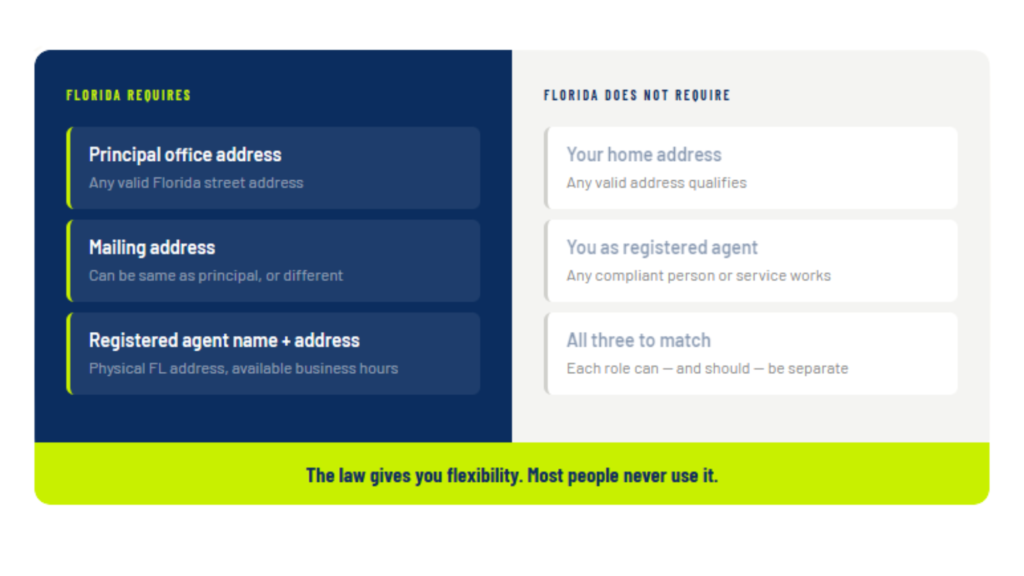
When you form an LLC in Florida, the Florida Division of Corporations requires three main address-related disclosures:
That’s it.
Now let’s break that down in plain language.
1. Principal Office Address
This is the main business address listed on your LLC filing.
It becomes public record.
It does not have to be your home.
It does not have to be where you physically work.
It simply must be a valid street address.
This is where most people default to their house because it feels obvious.
But Florida law does not say it must be your residence.
It says it must be an address.
That’s the distinction most people miss.
2. Mailing Address
This can be the same as your principal address.
Or different.
Also public.
This is where official correspondence may be directed.
Again, flexibility exists here.
Most people just duplicate their home address in both fields without realizing they have options.
3. Registered Agent Address
This one has specific requirements.
Under Florida LLC law, every LLC must designate a registered agent with:
- A physical street address in Florida
• Availability during normal business hours
• Written acceptance of the appointment
This address becomes public.
And this is where legal documents are delivered if your LLC is ever involved in a legal matter.
That means:
If you list yourself and use your home address, legal documents can be served there.
Some people are completely comfortable with that.
Others prefer separation.
The law doesn’t force you to use your home.
It forces you to designate a reliable Florida street address.
What Florida Does NOT Require
The system allows flexibility.
Most business owners just never slow down long enough to think strategically about how to use that flexibility.
Most people treat the address field like a checkbox.
But it’s actually a structural choice.
Here’s the calm truth.
Florida law is neutral.
It does not protect your privacy.
It does not force exposure.
It simply requires disclosure.
What you choose to disclose — within legal boundaries — is where strategy comes in.
And that’s the part most formation websites never explain.
So the real question becomes:
If the law gives you options, how should you think about choosing the right address structure?
That’s where we move next.
How to Choose the Right Address for Your Florida LLC
Here’s the shift.
Now that you know what Florida asks for, the real question becomes.
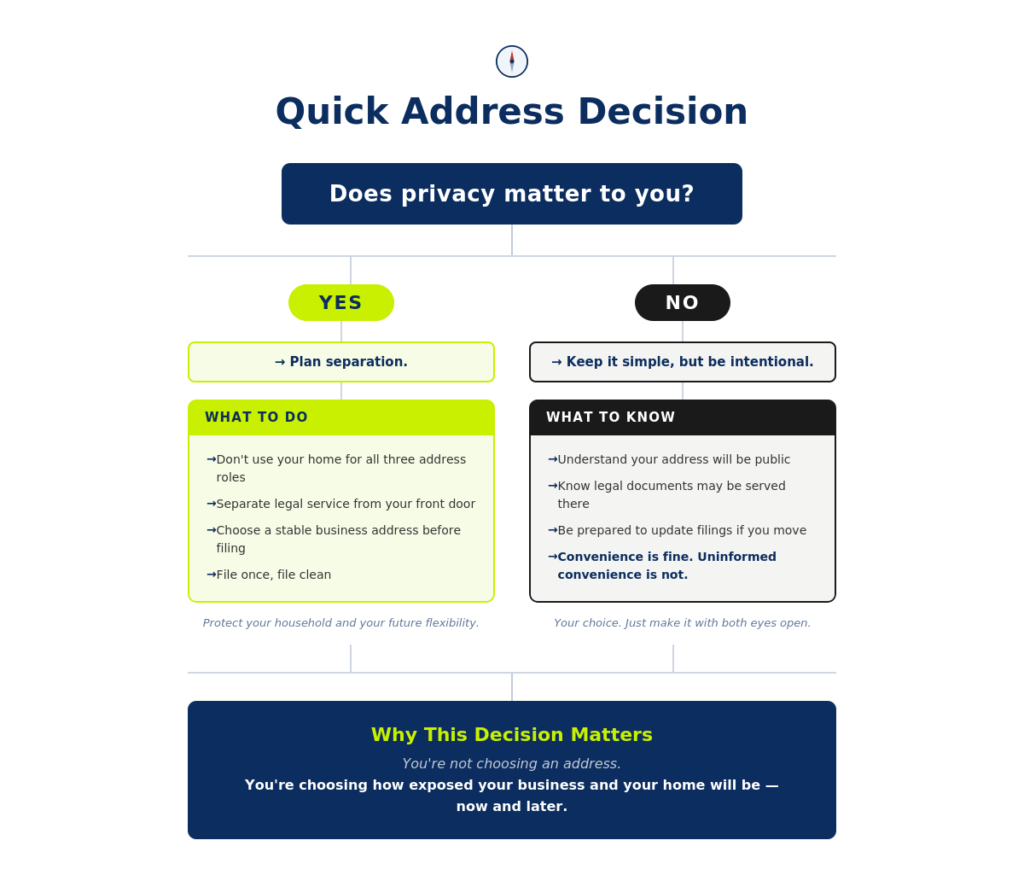
Do you want one address doing all the jobs… or do you want separation?
Most business owners use their home because it’s convenient.
Smart operators separate addresses based on function.
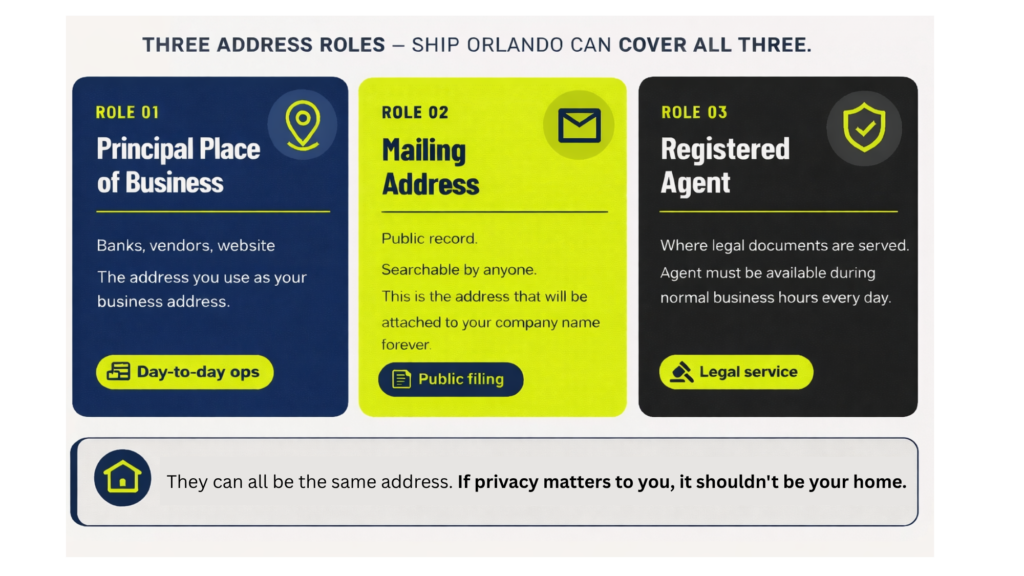
They use one compliant business address across all three roles — principal office, mailing address, and registered agent.
Not three different addresses.
One.
Just not their home.
That’s the separation that actually matters.
One thing most people don’t realize:
your registered agent is a separate role.
It’s not just another address you fill in.
It’s the person or service responsible for receiving legal documents on behalf of your business — and they have to be available during normal business hours to do it.
Some business owners list themselves.
Others don’t want that responsibility tied to their home or their schedule.
So they separate it.
That’s where structure starts to matter.
Because this isn’t about using multiple addresses just to use them.
It’s about deciding what belongs tied to your home — and what doesn’t
Should You Use Your Home Address for an LLC?
The better question is:
What happens when your business grows — and your home address is permanently tied to your company name in a public database?
Some founders are completely comfortable with that.
Others want:
• Privacy
• Stability if they move
• A more professional appearance
• A consistent footprint across filings
Neither is wrong.
But one is easier to scale.
If you think you might:
• Move in the next few years
• Grow your visibility
• Work with higher-value clients
• Apply for funding
• Sell the business one day
Then your address is not just a detail.
It’s part of your long-term structure.
Why Your Business Address Matters More Than Your Branding
Here’s where I’ll say something slightly opinionated.
Most new LLC owners spend hours choosing:
✔ A logo
✔ A font
✔ An Instagram handle
But very few pause long enough to think about:
→ Address permanence
→ Public record exposure
→ Administrative simplicity
Branding is easy to change.
Infrastructure is not.
You can redesign a logo in a weekend.
Changing your business address across 12 systems is not.
A Simple Way to Decide If You Should Use Your Home Address
Before you file, ask yourself:
- Do I want my home searchable with my business name?
- Am I likely to move within the next 3 to 5 years?
- Do I want separation between legal service and my front door?
If the answer to even one of those is yes —
A single compliant business address solves all three. Before you open Sunbiz.
This isn’t about fear.
It’s about designing forward.
Filing This Week?
Most people rush through this part.
Don’t.
Your address decision happens in minutes —
but it can follow your business for years.
Set it up right the first time.
👇
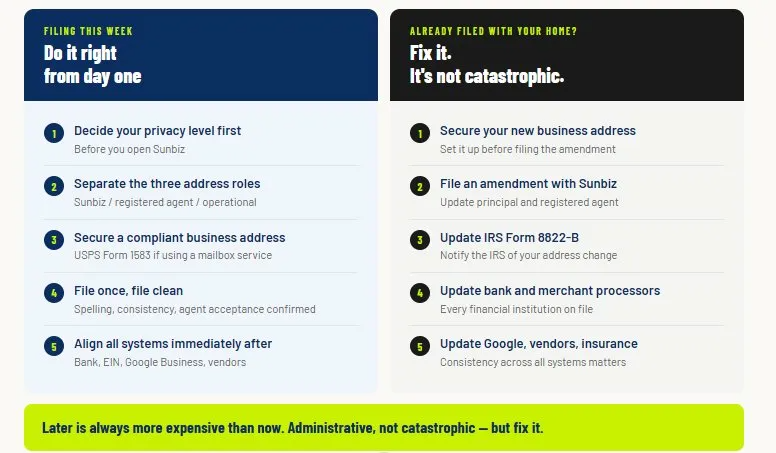
It’s fixable.
But fixing it later is always more work than doing it right the first time.
Florida LLC Address FAQs
Is my LLC address public in Florida?
Yes. The principal office address and registered agent address listed with the Florida Division of Corporations are publicly searchable.
Can I use a virtual address for my Florida LLC?
Yes, as long as the address is valid, properly authorized for mail receipt, and compliant with USPS regulations. It must meet Florida filing requirements and be appropriate for business use.
Can I change my Florida LLC address after filing?
Yes. You can update your address by filing an amendment or updating your annual report with Sunbiz. Historical filings remain part of the public record.
Do I have to use my home address for my Florida LLC?
No. Florida law does not require you to use your residence as your principal office address.
Do I need to complete USPS Form 1583 to use a private mailbox?
Yes. If you use a commercial mail receiving agency, federal USPS regulations require identity verification through Form 1583
One decision. Before you file.
You just read a lot.
Here’s the short version.
Your address goes public the moment you hit submit.
It stacks. It replicates.
And it’s harder to undo than it is to get right the first time.
Whether you’re filing this week or fixing a mistake — the answer is the same.
Set up your Ship Orlando address first.
One address.
All three fields covered.
Your home stays off the record.
This post is for informational purposes only and does not constitute legal advice. Every business situation is different. For questions specific to your LLC, consult a licensed Florida attorney or CPA.
